Engineering highlights
The hard parts, and how we solved them.
The problems that decide whether a product like this ships at all, and what solving each one means for the people using it.
01
Echo cancellation that keeps your voice
Laptop speakers leak the other side of the call into the mic, so the transcript hears everyone twice.
We record your mic and the call's audio as separate tracks, line them up, and strip the echo out, without cutting into your own speech when two people talk at once. Two earlier approaches did one or the other; we shipped only when it did both.
→Clean attribution: your words are yours, everyone else's are theirs
02
Recording the call without the scary permission
The usual way to record a Mac's audio asks for Screen Recording access, and many people say no.
Audio-only meetings use a narrower macOS audio permission, and screen access is only requested when someone actually wants video. On Windows the same capture needs no permission at all.
→No Screen Recording prompt for audio-only meetings
03
Onboarding that tells the truth
macOS can report a permission as granted when it isn't, and the app then quietly fails.
Hyprcore checks permissions the way the OS itself stores them rather than trusting a cached answer, and watches for the grant instead of waiting on a dialog that can hang.
→First run ends with your own words coming back, not a spinner
04
Floats over Zoom, stays out of your screen share
A recorder that steals focus mid-call, or shows up in the deck you're presenting, gets uninstalled.
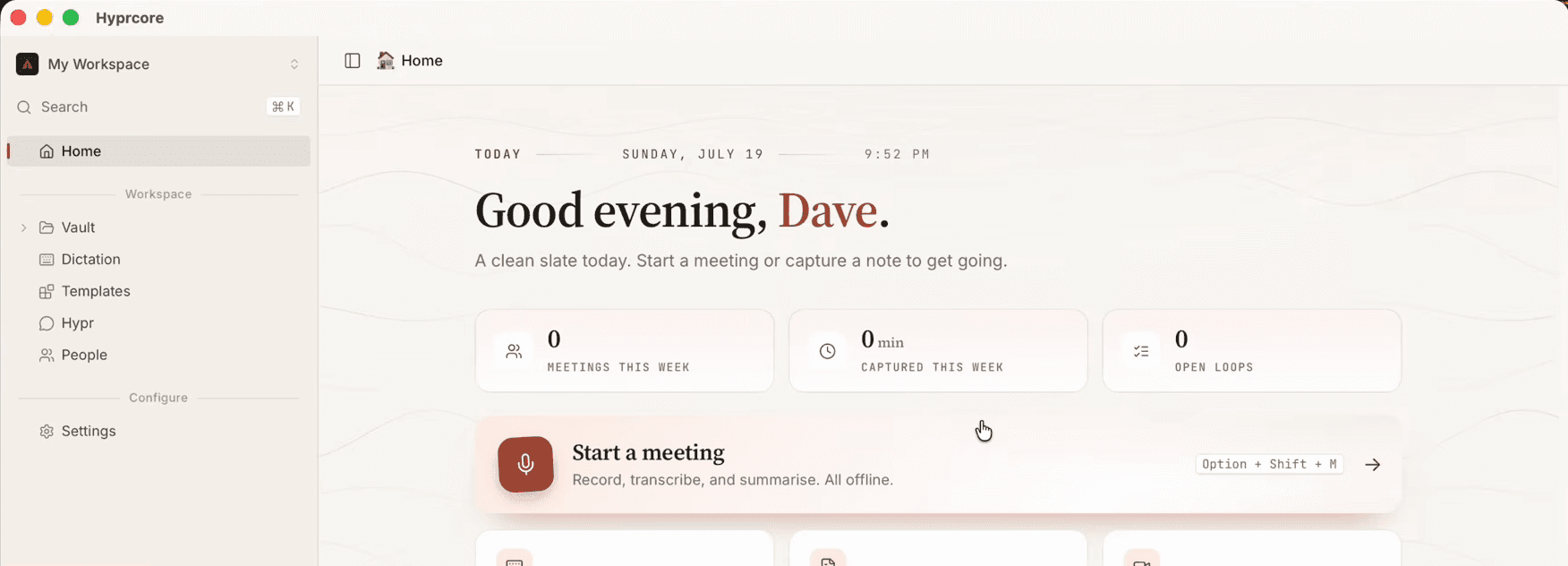
The recorder, banner and dictation pill are native floating panels that respond to a click without pulling focus from the meeting, and are hidden from screen capture.
→Present, take notes and record in the same call
05
Local, cloud or your own key, one switch
Some users want nothing to leave the laptop, others want the best cloud model, and the business needs a paid path.
Every transcription and AI call goes through one router the user controls: local only, cloud only, or somewhere between. The default is our own metered cloud, tied to their plan; their own API keys and local models are always an option.
→Privacy for users, a revenue path for the business
06
Accuracy we measure before we market it
Accuracy is the first thing a bad review complains about, and you can't protect what you don't measure.
Transcription and speaker-labelling accuracy are scored automatically against reference recordings, so a model or code change that makes things worse is caught before release, not by users.
→Word and speaker error rates tracked on every change